Orrefors Avanti Flute Champagne Review
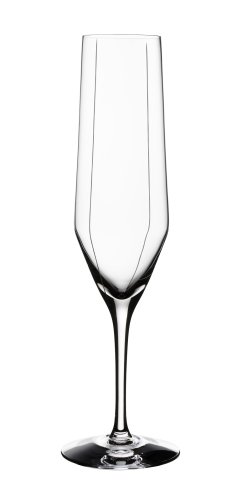
Straight lines and stylish cuts give Lena Bergström's new Avanti glasses an understated, sober appearance. Each glass is carefully designed to do justice to the drink for which it is intended. The wine glass, for example, features a generously large bowl with a beautifully tapering rim. The matt surface of the fine cuts making up the decor has a strangely primordial feel. Read more...
Orrefors Avanti Flute Champagne Specifications
Founded in 1898, Orrefors has long been a favorite with design enthusiasts for its artistic exploration of glass as a medium. With the Avanti collection, the company creates a modern look with classic appeal--distinctive, handsome, and thoughtful in mood. Designed by artist Lena Bergström, the streamlined beverage collection features straight-edged silhouettes and confidently angular cuts. Strong but slender stems and round feet complete the profiles, while matte finishes on the cuts add an understated but stylish element.
Suited to sophisticated gatherings or intimate celebrations, the Avanti flute enhances the pleasures of champagne and sparkling cocktails. The classically elongated bowl takes a modern edge from the signature Avanti lines, while the stem is pleasant in the fingers. Standing approximately 9-1/4 inches high, the lead-free glass is handmade in Orrefors' Swedish glassworks. Coordinating wine and cocktail pieces are also available. Washing by hand is recommended. --Emily Bedard
From the Manufacturer
 | About the Designer: Born in 1961, Lena Bergström is a successful designer of both textiles and glass. She has received numerous public commissions and has won Excellent Swedish Design awards for six of her glass collections, among them Squeeze and Puck. Lena received her artistic education at the College of Arts, Crafts and Design in Stockholm before coming to Orrefors to participate in a design project in 1993 and 1994--she was captivated by glass and has been affiliated with Orrefors since 1994. She has an unerring sense of design; her work, soft of line yet graphically eloquent, represents a new generation of expression. Cyrano, Roma, Lightstones, Wa, Pastill, and Sopranos are typical examples of her art. Recent production includes the Colore vases, the black-and-white Pingvin, and Calypso, which is a refinement of Orrefors's famous Fuga technique. |
With characteristic craftsmanship and good design, Kosta Boda has become one of the leading glasshouses in the world. The company's three glassworks in the villages of Kosta, Boda, and Åfors each have exciting individual stories of their own yet stand together under the common brand name Kosta Boda. The corps of designers currently on retainer at Kosta Boda works with both utilitarian and art glass.
Glass results from a great many meetings between people--artists, craftspeople, and lovers of glass. The artists of Kosta Boda have a decisive role to play in all the creative stages of the process. The cooperation between the designers and the skilled craftspeople is very close; indeed, it is essential if the designers are to transfer their intentions to the glass.
The History of Kosta Boda:
Kosta, the parent glassworks of Kosta Boda and the oldest glassworks in Sweden still in operation, has a fascinating history that forms a valuable part of Swedish cultural heritage. The glassworks was founded in 1742 by the governors of the counties of Kronoberg and Kalmar, Anders Koskull and Georg Bogislaus Stael von Holstein, both former generals in the army of Karl XII and distinguished veterans of the battle of Narva, among others. The two county governors founded the glassworks upon the instructions of Fredrik I and modeled it on Continental glassworks. The works was situated deep in the spruce forests of Småland, on a site midway between the two country towns, and near a village that was then known as Dåfvedshult. The main reason for choosing this location was the unlimited availability of wood. Enormous quantities of wood were naturally required to keep the glassmaking furnaces burning day and night.

Both of the founders wanted their names to be remembered, so the works was christened Kosta, from the initial letters--Ko and Sta--of the surnames of both the Carolinian generals. After a time the entire community was renamed after the growing glassworks.
During the first 150 years, the glassworks in Kosta produced only utility glass, including window glass for the building of Tessin's Royal Palace, bottles and glass for the royal household, and chandeliers for churches. The first glassblowers were immigrant glass masters from Böhmen. They became the founding fathers of the glassblowing families, which passed down craft skills from generation to generation. Swedish sand was used to manufacture crystal glass, but nowadays pure silica sand is imported from Belgium, since the Swedish sand contains iron oxide that gives the glass a green tinge.
Under the management of glass masters from Kosta, a succession of glassworks sprang up in the forests of Småland in the regions around Växjö and Kalmar. Kosta therefore has good reason to call itself the parent works of the entire Swedish Kingdom of Crystal.

Until the end of the 19th century, the glass from Kosta was designed by the glassblowers themselves. At the Stockholm exhibition in 1897, the glassworks was criticized for the uniformity of its glass, which led to the idea of enlisting designers and artists in production. The first designer to be employed by Kosta was Gunnar Wennerberg. The year was 1898. Ever since then a large number of artists and designers have enriched the glassmaking tradition of the works with their artistic talents. Today Kosta Boda has a unique right to describe itself as an art industry, in which designers and craftspeople work closely together in the ongoing development of handmade utility glass and art glass. This diversity of individual artistic expression and the free and uninhibited creative process have become the distinguishing characteristics of the Kosta Boda brand.
In addition to the parent works in Kosta, Kosta Boda today includes the two "daughter works" of Boda (founded in 1864) and Åfors (founded in 1876), a partnership that was formed in 1964. Both Boda and Åfors were originally relatively simple glassworks that manufactured utility glass. Boda experienced a period of glory in the 1960s and 1970s, under the innovative and dynamic artistic leadership of Erik Höglund, a heritage carried on by Kjell Engman and Monica Backström. Åfors has been the home of the designer couple Ulrica Hydman-Vallien and Bertil Vallien, who, together with Gunnel Sahlin and Olle Brozén, brought a renaissance to the small glassworks and local community. In 1990 Kosta was acquired by its former competitor Orrefors. Orrefors/Kosta Boda was in turn acquired by the Danish company Royal Copenhagen in 1997, and the design group Royal Scandinavia was formed. The group also includes Georg Jensen, Royal Copenhagen, and Holmegaard.
Colorful, handmade art glass from the works in Kosta, Boda, and Åfors have made Kosta Boda one of Sweden's strongest brands and one of the world's leading glass companies. Glass from Kosta Boda is sold all over the world. Roughly 50 percent of production is sold outside Scandinavia, with some of the biggest markets in the U.S., Japan, Germany, and Australia. The origins of this glass, the living tradition of craftsmanship developed in the glassworks in Kosta, Boda, and Åfors, is a heritage that every Swede has a right to feel proud of.
Taking Care of Kosta Boda Pieces:
Handmade and hand-painted glass (especially the latter) does not do well in the dishwasher. Wash by hand in hot water--though not too hot--with a little washing-up liquid. Washing in very hot water will eventually destroy the luster of the glass. Rinse in water of about the same temperature as you washed it in. To avoid cracking the glass, make sure you do not expose it to excessive temperature differences. To avoid lines, dry with a soft cloth that won't shed lint. The edge of the glass is its most fragile part. When you put the glass back in the cupboard, stand it on its foot and make sure the edge does not come into contact with other glasses or objects.
The Mark or Signature on Kosta Boda Pieces:
Products are marked with the words Kosta Boda, the name of the artist, and the article number (seven digits). Painted pieces are signed with a painted signature with the designer's and the painter's initials. Engraved pieces also have the engraver's signature near the designer's name.
Besides designing glass for the regular Kosta Boda collection, our artists are also free to work with art glass--limited-edition, specially signed pieces that are often much sought after by collectors. Kosta Boda art glass is divided into two categories: unique pieces and limited editions. Unique pieces are, of course, just that. No more than one piece is made of any particular item. Limited editions are manufactured in runs of between 25 and 1,000 pieces. All art glass is marked with the product number, the name of the artist, and the size of the edition so that the purchaser will know exactly how many pieces there are in that particular series. Editions comprising less than 60 pieces are individually numbered, e.g. "25/60."
Free Shipping Orrefors Avanti Flute Champagne @ Amazon.com

0 comments:
Post a Comment